Case Study 04 · AI Content Workflow
How I cut editorial production time by 79% using custom AI content workflows
The brief
The Cafemutual editorial team was producing 3–5 articles a day. Each one took around 3.5 hours from start to publish. Good journalists, good content, but a slow process that couldn't scale.
I built an AI content workflow that brought that time down to 45 minutes per article. Then built a content multiplication system that turned each article into six formats automatically. Then made sure the editorial team actually used it.
At a glance
Cafemutual Editorial
Daily financial news and analysis for India's MFD ecosystem. 3–5 articles/day. Regulatory monitoring across AMFI, SEBI, IRDAI, PFRDA. Conference recordings from SIF Summit, Beyond Borders. Content trapped in one format.
The challenge
Daily regulatory monitoring consumed 40% of editorial bandwidth before a single word was written. Conference recordings sat unprocessed for days. Good content never left the article format.
Regulatory monitoring burden
Manually scanning AMFI, SEBI, IRDAI, and PFRDA updates every morning consumed 40% of editorial bandwidth, before any actual writing began.
Slow conference transcription
Each conference session from SIF Summit or Beyond Borders took 5 hours to transcribe, structure, and write up. A significant backlog built up after every event.
Content stuck in one format
An article that could become a LinkedIn carousel, a reel, a YouTube explainer, and five social posts stayed as just an article. Distribution potential left on the table daily.
The solution
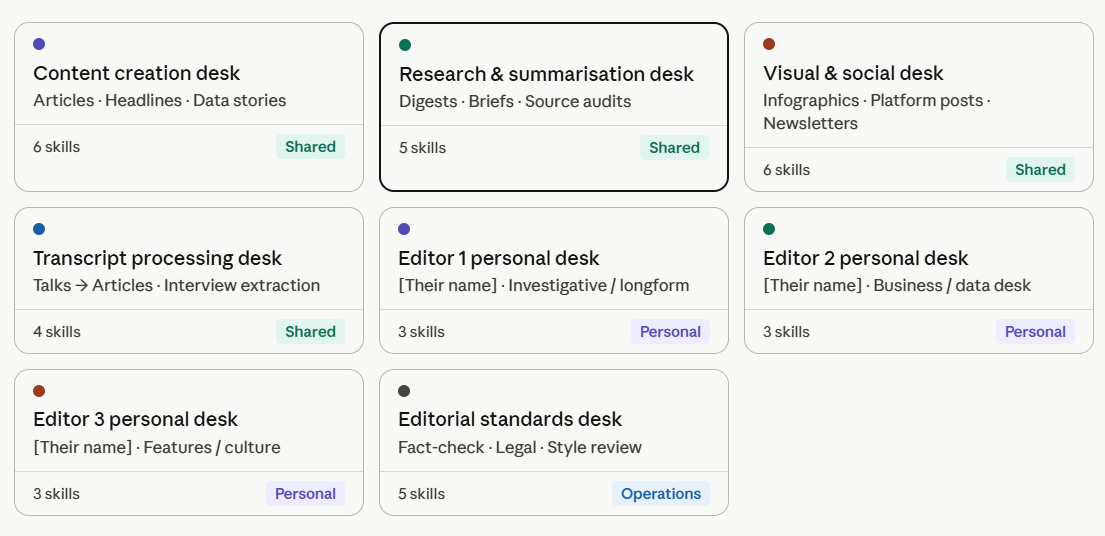
Built six custom Claude AI desks for the editorial team.
Editorial Standards Desk, Transcript Desk, Research Desk, Content Creation Desk, Visual & Social Media Desk, and Summarisation Desk. Each had a specific role. Writers used them for research, drafting, formatting, and repurposing.
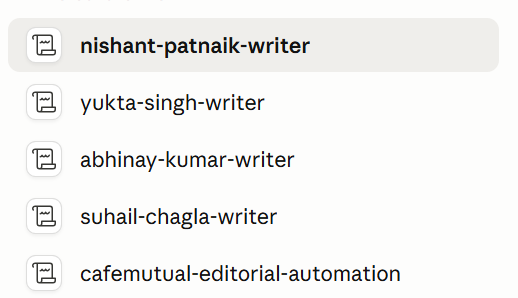
Trained writer-specific models on each journalist's past work.
20–30 past articles per person. The output replicated their individual tone, depth, and analytical style. This is what separates useful AI from generic content nobody wants to publish.
Video transcription pipeline via Whisper API.
Conference recordings became publish-ready articles in one hour of review instead of five hours of manual work. Built in Google Colab. Every session from every event processed at scale.
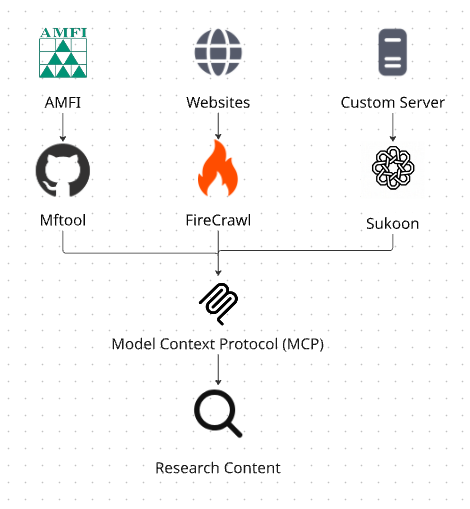
Automated daily regulatory monitoring.
Firecrawl MCP + Sukoon MCP delivered a daily digest of new AMFI, SEBI, IRDAI, and PFRDA updates every morning, without anyone having to search for them.
Content multiplication pipeline: 1 article → 6 formats.
LinkedIn carousel, Instagram reel, YouTube explainer, podcast, presentation deck, and 5+ social posts. Using Opus Clip, Gamma, Revid AI, Monica AI, and HeyGen at ₹10,400/month total, versus ₹35,000+ for equivalent commercial platforms.
Results
Key takeaways
01
AI adoption fails when it's imposed. It works when the people using it help build it. Involve the team early, the prompts were built collaboratively, so the team felt ownership.
02
Training AI on a specific writer's past work is what separates useful content assistance from generic output nobody wants to publish.
03
The bottleneck is rarely writing. It's research, transcription, and distribution. Automate those and the writing becomes faster by default.
Want AI built
into your content ops?
Not theoretical frameworks. Working systems that your team will actually use.
Connect on LinkedIn ↗